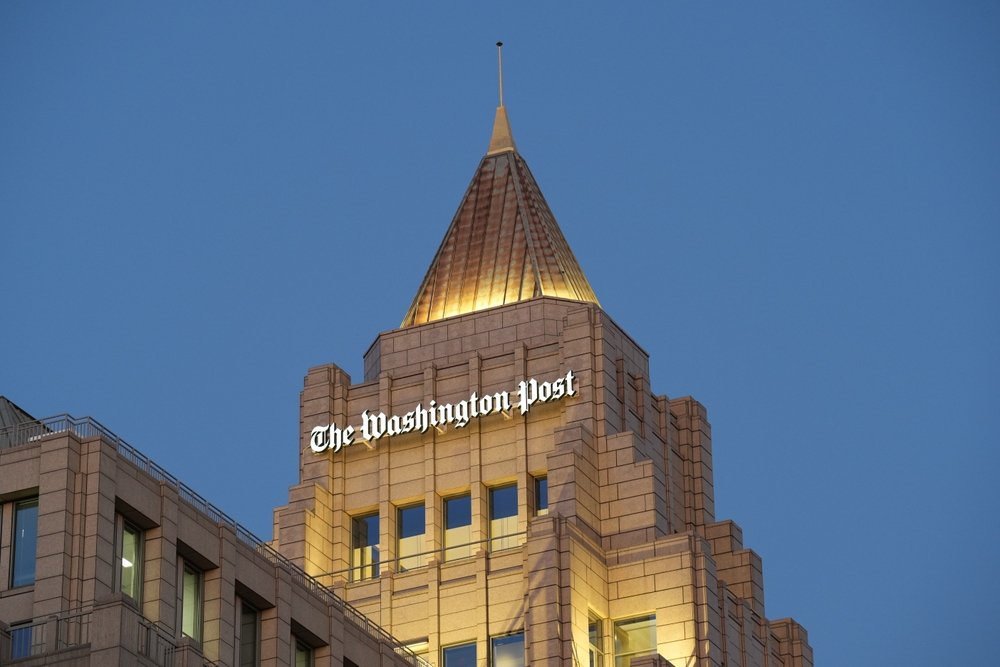
The latest round of layoffs cap a tumultuous 18 months for The Post, which Bezos purchased in 2013. The newspaper has undergone significant leadership changes and was roiled by a decision from Bezos and publisher Will Lewis to scrap a planned editorial that would have endorsed then-Vice President Kamala Harris over now-President Donald Trump shortly before the November 2024 election.
The decision led to several resignations in the opinions section and a reader revolt. It preceded a makeover of the newspaper’s opinions desk, which Bezos said he reformed to focus on “personal liberties and free markets.” And in early 2025, the paper offered buyouts to much of its staff, which saw several top stars decamp to competing publications.
Murray’s note to the newsroom said the paper will “concentrate on areas that demonstrate authority, distinctiveness, and impact,” naming sections like politics, national security, science, technology and business.
Yawn.
Yeah, it sucks when your job gets blown up.
But the employees at the Washington Post have been, for far longer than Jeff Bezos has owned it, almost universally in favor of an ideology that is injurious to prosperity, entrepreneurship, and behavioral success.
Another way to say this is that the destruction of wealth — personal, community, and national — has been the chief philosophical pursuit at the Washington Post for quite some time.
Ronald Reagan summed up that philosophy pretty well:
Well, Bezos has been subsidizing it since 2013.
The Washington Post has been losing money hand over fist for more than a dozen years now, and it’s proof of the veracity of another famous saying, this one by Charles Krauthammer, among others: “That which cannot continue, won’t.”
You can’t keep losing money forever. Things don’t exist to diminish. If you don’t produce anything, you will ultimately perish.
And the Washington Post has been losing its owners money for two decades now.
Yes, but money isn’t everything, right?
It’s too bad that sanctimony can’t be monetized. Otherwise this would sustain the Post into the next millennium:
“This ranks among the darkest days in the history of one of the world’s greatest news organizations,” said Marty Baron, former executive editor of The Post. “The Washington Post’s ambitions will be sharply diminished, its talented and brave staff will be further depleted, and the public will be denied the ground-level, fact-based reporting in our communities and around the world that is needed more than ever.”
Lighten up, Marty.
Nobody has believed the Washington Post was a great news organization since the previous century. It’s been a disgrace, in the eyes of the majority of the American public, at least since George W. Bush was elected, and its subscribership has been on the wane since. The Washington Post employed Jen Rubin and Taylor Lorenz, for crying out loud.
Yes, you say, but that’s to do with the internet. Sure, that’s certainly true, but it doesn’t make the point you think it does. It turns out that the internet is, on balance, a superior news medium than is newsprint (and I say this as someone who used to publish a print publication). The internet provides for dynamic content, audio and video, live streaming, and lots of other things you can’t get from print. And it doesn’t require the use of a printing press to disseminate information.
Which means the market isn’t in need of legacy prestige publications like the Washington Post like it once was, and so the trappings of significance that publication has carried far past the reality of its circumstances have made for red ink.
And lots of it.
The Post loses money because it ran off the conservative side of its subscription base, and then, when it attempted to recover some sort of balance by refusing to endorse the farcical Kamala Harris in 2024, it ran off the leftist subscribers who remained. And it did these things at a time when it was of decreasing necessity to have a bloated, lavish news agency like the Post to cover events from sea to shining sea.
So eventually the destruction of wealth by incompetent people — both businessmen and journalists — was going to result in a correction. Bezos doesn’t have a perfect record of brilliance in business — he bought this turkey in the first place, after all — but he did build Amazon from nothing and therefore he does understand the concept of a long-term business vision and how that compares to a lack of one.
When you see the inevitable carnage at the Post, it does give you perspective on other things. For example, the ratings came out for the Grammy awards — and they’re not very good.
The final Grammy Awards on CBS took a small ratings hit compared to the previous year.
Sunday’s telecast of the 68th Grammys averaged 14.41 million viewers, according to big data plus panel same-day ratings from Nielsen. That’s down a little more than 6 percent from the 15.4 million who watched the 2025 show. The Grammys audience shrank some for the second consecutive year since hitting a post-pandemic high of 17.09 million viewers in 2024.
CBS has aired three of the four EGOT awards shows in 2025-26, starting with the Emmys in September, and has had mixed ratings results. The Emmys improved year to year (vs. ABC’s telecast in 2024) for their largest audience since 2021, but the Golden Globes in January declined by about the same amount (6.5 percent) as the Grammys. ABC will close out the awards season rush with the Oscars on March 15.
It turns out that having to listen to the insufferable dunce Billie Eilish bleat out that “No one is illegal on stolen land” — which shortly introduced to the American public a tribe of indigenous people named the Tongva, on whose ancestral real estate Eilish’s multimillion-dollar mansion sits, and the Tongva have now made a not-so-sarcastic demand for her eviction — isn’t all that conducive to profitable television. (READ MORE: Give It Back, Then)
Or music, for that matter. Eilish might be a hot seller here and there, but on the whole, the record industry is basically a corpse — and what keeps it from rotting away these days is the one form of music — that being country — which is dominated by people who would very much like for Billie Eilish to close her pie hole. It’s difficult to see how Eilish, or the bearded, dress-wearing Puerto Rican hip-hopper Bad Bunny, publicly bitching about ICE deportations that the American people are pretty happy about will save the business.
Industry by industry, we see that the Left and its votaries are actively destroying wealth. The cities they rule are in ruins, the government treasuries they’ve pillaged are empty, the social programs they’ve touted and run are corrupt and bankrupt, and the institutions they dominate are less relevant and in pronounced decline.
Zohran Mamdani has been mayor of New York for less than a month and there is this…
Another old saying, this one by Adam Smith, is “There is a lot of ruin in a nation.” A lot, yes, but not an infinite amount. And from the Post to the record business to the burgeoning dysfunction of communist New York, we’re beginning to see that ruin has consequences.
Bad ones.
Here’s hoping the Post employees can find gainful employment. But along the way, let’s also hope they learn a lesson from the decline of their former employer — which is that serving an ideology, rather than the public good or the needs of the market, ultimately isn’t a sustainable pursuit.
As for Billie Eilish, one surmises she’ll be fine — whether the tribesmen of the Tongva repossess her house or not. Thought we do wish the best of luck to her in expanding her audience beyond mentally deranged Gen Z females. She’ll need it.
READ MORE from Scott McKay:
The Med-Mal Floodgates Are Open Thanks to the Fox Varian Case, and Thank God for That





![Donald Trump Slams Chicago Leaders After Train Attack Leaves Woman Critically Burned [WATCH]](https://www.right2024.com/wp-content/uploads/2025/11/Trump-Torches-Powell-at-Investment-Forum-Presses-Scott-Bessent-to-350x250.jpg)
![Kamala Comes Unglued, Makes Bogus Claim About Her Landslide Loss to Trump [WATCH]](https://www.right2024.com/wp-content/uploads/2025/10/Kamala-Comes-Unglued-Makes-Bogus-Claim-About-Her-Landslide-Loss-350x250.jpg)