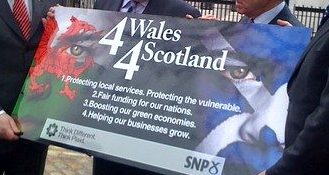
As we approach our seventh set of elections to the Scottish Parliament and the Welsh Senedd, previously Assembly, it’s time to point out something that almost no-one in mainstream politics wants to say.
Devolution in its current form has been a tragic failure.
In 1999, Scotland had better public services in many respects than England, and the same taxes. It now has worse public services, and higher taxes. In Wales, devolution is literally costing lives. A single health board, Betsi Cadwaladr, serving 650,000 people, has kept 5,600 of those people on a waiting list for more than two years. The number of patients waiting more than two years across the whole of England (population 56 million) is 172.
Groupthink, pervasive enough at Westminster, is utterly dominant in Scotland and Wales, because the governing and opinion-forming classes are so small that groupthink becomes socially difficult to oppose. In Scotland, even the Conservatives signed on to the ridiculous All-Party Parliamentary Group definition of Islamophobia – the one that said accusing Pakistani men of disproportionate involvement in child grooming was Islamophobic, and should be banned.
The line of least resistance with activists, identity politics and producer interests is so often pursued. When I reported on the Scottish government’s plans for transgender self-ID, I found ministers had created an almost perfectly circular bubble of supposed “pressure groups,” 90 per cent funded by the Scottish government, who’d co-designed the policy behind the scenes, then provided a supposedly “independent” chorus of support for it. It was like East Germany with added teacakes: no wonder decision making is so bad.
Devolution hasn’t even fulfilled its unspoken purpose, to neuter nationalism. Quite the opposite. The SNP-operated grievance mill in Edinburgh will next week be joined by a Plaid Cymru-operated grievance mill in Cardiff. Neither of these parties is in any way serious about tackling the challenges their nations face. New boys Plaid want only to intensify the brain-dead policies of tax-and-spend which Welsh Labour has been trying for the last 27 years. Nor, indeed, is it in their interests to tackle the challenges – they don’t want to succeed as part of the UK.
None of that means we should end or even reduce devolution. In Scotland, it would break a promise made in the 2014 referendum, and could give the Nats the grievance they need to push independence over the line. It would also be quite difficult in Wales despite lower support for the institutions there (it’s often forgotten that the Welsh people voted Yes by only 0.6 per cent in the referendum to set up the Assembly; if four thousand votes had gone the other way, Wales would not have had devolution.) What it means is trying to make devolution work better for the people of Scotland and Wales.
I suggest three main reforms, though there will be others. Firstly, more devolution. No, not hand over more powers from Westminster – the Gordon Brown answer, which has been done multiple times already and not worked. Devolve powers from Holyrood and Cardiff Bay. Devolve them to local authorities and local people. The other great paradox and failure of devolution, particularly in Scotland, is that it has moved power over many services further away, not closer. Policing in Scotland has been centralised, badly. Local government is kept on a tight leash. No-one in the Tory-voting Borders or Labour Fife can try a different way of law and order, or housing, or many other things, from the way decreed in Edinburgh.
I would create directly-elected lord provosts in Scotland’s four big cities, directly elected mayors in Cardiff and Swansea, and perhaps in any other area that wanted one. I’d give them entrenched powers over tax-raising, spending and services. They probably wouldn’t all be SNP or Plaid. They’d be big figures, getting plenty of attention, and they’d provide a bit of the challenge and the pluralism that Scotland and Wales lack.
My second reform would be to hold elections for the devolved parliaments on the same day as the Westminster election, as some American states do with the US presidential elections. Not with the same candidates, or the same electoral system. Voters would be free to split their ballots. It would take some working out, because Westminster, unlike the devolved parliaments, does not have fixed terms. Exceptions might have to be made if a Westminster election is called after less than, say, a four-year term. But it might produce devolved administrations who were a bit more willing to work with Westminster.
My third reform would be of the institutions. I’d set up a UK body with real teeth, a souped-up version of the National Audit Office, to monitor performance of both the Westminster government and the devolved governments, comparing them with each other in real-time, pressing to share best practice across the UK and never being afraid to call out failure in any of the three capitals.
My antidote – or at least my palliative – for groupthink would be reforms to the Senedd and Holyrood. Both are parliaments set up to provide the appearance of scrutiny, without enough of the reality. Despite – no, because of – their inclusive patter and hemicycle seating, they are far worse at getting information out of ministers than horrid old Westminster, with its adversarial layout and MPs shouting at each other. Contrast, say, the Alex Salmond scandal with the Peter Mandelson one. In Holyrood, MSPs need permission from their whips to speak in debates, rewarding conformity. The main check on executive power was supposed to be the electoral system, supposedly preventing any party gaining a majority. But the SNP did gain a majority in 2011, and has governed in a majoritarian fashion even since it fell just below one in 2016. The scrutiny structures weren’t set up to deal with that.
I dare say none of this will happen.
Part of the problem is that the Scottish and Welsh parliaments are seen by nationalists not just as democratic institutions, but as symbols of national identity. Any attempt to devolve their powers downwards, improve the poor job they do or incentivise them to work better with others will be a “Westminster attack on Scotland” or a “Westminster attack on Wales.”
But that attitude is precisely what needs to change.




![Kamala Comes Unglued, Makes Bogus Claim About Her Landslide Loss to Trump [WATCH]](https://www.right2024.com/wp-content/uploads/2025/10/Kamala-Comes-Unglued-Makes-Bogus-Claim-About-Her-Landslide-Loss-350x250.jpg)




![CNN's Kaitlan Collins Fact-Checks Rep. Jasmine Crockett Over False Trump Ballroom Claim [WATCH]](https://www.right2024.com/wp-content/uploads/2025/10/1761954330_CNNs-Kaitlan-Collins-Fact-Checks-Rep-Jasmine-Crockett-Over-False-Trump-350x250.jpg)