Anne-Marie Trevelyan is a former MP, Secretary of State for International Development, for Business and a former Foreign Office Minister.
The latest cycle of local elections has just swept across the UK, mostly leaving voters tired of the negative campaigning between Reform, Labour and the Greens.
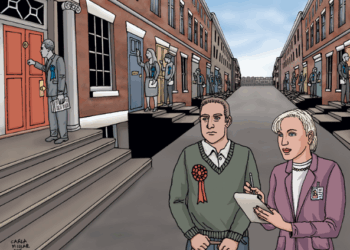
Citizens who bothered to cast their democratic vote are wondering if their choice will deliver what they want. If turnout hits 40 per cent, I will be impressed. As a former MP and knocker-on-doors for the last 30 years, the reality is that whilst bins, local schools and roads are what local councils can do for the voter, unsurprisingly the big national issues of the day – this time round, energy prices and illegal migration – have dominated doorstep debate.
As the voter ask themselves “what can the person I am voting for do for me” before applying a cross next to a name, often they are also picking the political party they hear offering them the big national solutions they want. These local elections are not going to solve those – it’s been all about picking the councillors who will work together (hopefully) to run local services. The challenges of energy prices, impacts on daily life at home and at work, and the ever-present question of illegal migration are concerns for many voters which will remain unresolved by this round of voting.
So as a former MP and Minister, I believe that the ability to chat on the doorstep to voters about their thinking, their concerns, their aspirations for their family, is more important than ever. Ministerial experience is not only valuable but often essential, to explain to voters what they are choosing and why, as well as to take every opportunity to hear from them what is important to them. As households grapple with rising bills, higher taxes and less security at work, and businesses are calculating the cost of keeping their doors open, clarity matters. Those of us who have been ministers, who have sat at the intersection of policy, regulation, and long‑term national strategy, have a responsibility and opportunity to give honest answers.
Local elections are, by design, about local priorities: roads, planning, waste collection, community services. But voters do not compartmentalise their lives. They do not stop worrying about their heating bills simply because they are choosing a councillor rather than an MP. The cost of energy affects every aspect of daily life, and local leaders—no matter how dedicated—cannot be expected to carry the burden of explaining global energy markets or national regulatory frameworks. The belief that their community has become less safe due to influx of illegal migrants may be real or imagined, but the sense of unease is honestly felt and needs addressing. That is where ministers and MPs can and should step in.
Energy prices are shaped by forces from international markets pricing, the variations in domestic energy storage and delivery infrastructure, regulations and long‑term investment decisions. Ministers have the vantage point to explain this complexity honestly, and as a former energy minister myself have found this conversation a regular one on the doorstep and in every event I attend.
Does shutting off the UK’s oil and gas resources in the North Sea make sense if we then have to import more, thereby creating less energy security?
Should the conversation be all about “clean” electricity meaning wind and solar industrial sites across farmland, when gas is critical for the foreseeable for our heating as well as electricity generation, and road transport will need diesel for decades yet? Investing in nuclear power, large and small sites, will be critical to creating the vast extra requirement needed for stable grid use as well as for the data centres we demand to underpin our digital world and hunger for AI.
What does the local council have to do with any of this?
They can make their planning decisions clean energy friendly, and encourage the nuclear & data centre sites needed for great jobs and stable power for the next 50 years, or they can choose intermittent renewables which add some electricity to the grid but are unreliable. It has always struck me that it’s often on the coldest days that there is no wind. At that point we either fire up gas power stations or import from other countries. No improvement to our domestic security there – as Germany discovered, gas pipelines attacked causes enormous repercussions. The Russian submarines cruising UK waters these days know exactly where our interconnectors from Norway & France are.
So, on those doorstep chats, trying to ensure that a fuller picture is shared, and that public debate avoids becoming distorted by oversimplification or, worse, misinformation, is really important to me. Voters deserve that.
What do local authorities influence and what is outside their control?
On energy, councils play a vital role in energy efficiency programmes, planning decisions for renewable infrastructure, and supporting vulnerable households. They can lobby central government to improve on all of those on behalf of their voters. What local councillors cannot do is set wholesale gas prices, negotiate international supply contracts, or regulate national energy companies.
On the housing of illegal migrants, councils have a choice on whether to be part of Home Office re-housing, or not.
For councils like Kent where the duty of care for children kicks in regardless, their services become overwhelmed. For most other councils, it is a choice whether to approve temporary housing for illegal immigrants, with all the challenges that this has been bringing to local communities. The bigger challenge belongs to central government to tackle – small boat numbers rising faster than ever since the deterrent effect of the Rwanda policy was removed in 2024. The choices made in these local elections reflects frustration at that – a protest vote against the Labour Government’s policy decisions – rather than a challenge to the local council on how they engage with central government and exert pressure by representing local people’s concerns.
Some argue that ministers should keep out of local election discussion, suggesting that their involvement politicises issues that should remain community‑focused. But this misunderstands the nature of modern governance. Energy policy is inherently national, but its consequences are felt in every home and high street. The realities of migration policies which demand good community integration and border protections are tackled by long-term hard choices which put British citizens first. If we don’t then our social cohesion is threatened and that brings no benefit to anyone but those who wish us harm.
When voters are asking national questions, it is only right that national leaders provide national answers. Silence would not depoliticise the issue; it would simply leave a vacuum for speculation. Local elections are a moment to highlight the partnership between national and local government. Councils are essential delivery partners for central government policy choices, from initiatives like home insulation schemes to electric vehicle infrastructure, and from high street investment to housing numbers and who gets them. Politics is important at every level – the most important of which is using that precious right to vote.
Here’s hoping for some decent turnout results, whatever the choices made by voters.
![Kamala Comes Unglued, Makes Bogus Claim About Her Landslide Loss to Trump [WATCH]](https://www.right2024.com/wp-content/uploads/2025/10/Kamala-Comes-Unglued-Makes-Bogus-Claim-About-Her-Landslide-Loss-350x250.jpg)




![CNN's Kaitlan Collins Fact-Checks Rep. Jasmine Crockett Over False Trump Ballroom Claim [WATCH]](https://www.right2024.com/wp-content/uploads/2025/10/1761954330_CNNs-Kaitlan-Collins-Fact-Checks-Rep-Jasmine-Crockett-Over-False-Trump-350x250.jpg)