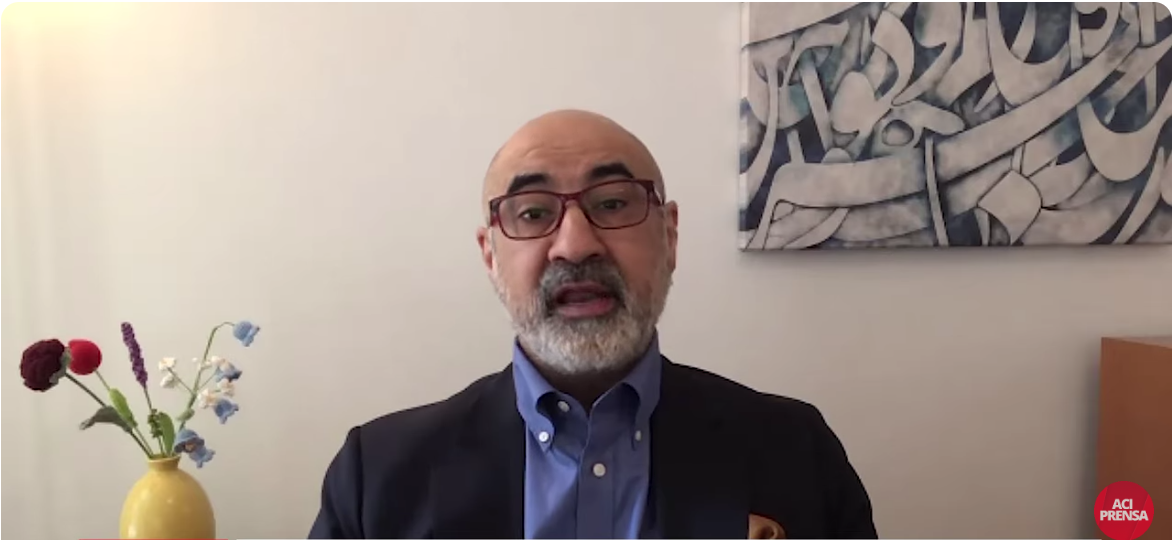
Kian Tajbakhsh, a geopolitical expert and former political prisoner in Iran, shared his testimony regarding what life is like in Iran as well as his hopes for the future of the country, where he says “religious freedom does not exist.”
Iran is a country with a population of over 90 million inhabitants, where only “between 10% and 15% support the current regime or government” amid the current war, the specialist stated in an interview with “EWTN Noticias,” the Spanish-language broadcast edition of EWTN News.
“Perhaps half of them are true believers — religious fanatics or even extremists — while the other half are people who depend on the regime for their livelihoods, their children’s schools, hospitals, pensions, etc.; they depend on the government and the regime,” he observed.
In his view, another 30% “are politically neutral,” and their “primary interest is the safety of their children and families.” The remaining 50% or 60%, he estimated, “oppose the regime and would like to live under a free, liberal, secular, and Westernized government.”
Life for each of these groups is different, the expert explained.
“In the current war, those who support the regime are in the streets; they support the war, they support the fight against the United States, the continuation of nuclear programs, etc.,” while opponents of the government “mostly fear speaking out because in doing so they are brutally repressed and even killed by the regime,” much like the thousands of people who died in the January demonstrations.
Prisons in Iran
The Iranian political scientist said the country’s prisons fall “somewhere in between” those in Europe and those in some parts of Asia where everything “is very dangerous, there are no medical facilities, and there is no access to the rule of law.”
“The problem in Iran is that there are no civil rights; there’s no access to lawyers. I lived in a cell barely 6 feet across, perhaps 2 meters by 3 meters [about 6 inches by 10 inches] for over a year in solitary confinement,” he recounted.
Tajbakhsh pointed out that if one is in prison for “peaceful political activism” as happened to him, what happens is that “you don’t have access to a lawyer until very, very late in the process. They interrogate you for many, many hours for many months.” Consequently, “the biggest problem is that in Iran there is no fair judicial system for political prisoners.”
Hope for Iran
The expert commented that since 1979, “the majority of the Iranian people have attempted to reform the government by transforming it into a freer, more liberal, and democratic government that respects all religious values, religious freedom, as well as political and social freedom.”
“While it is deeply tragic that war and conflict are part of this process, I fear that it is the government of Iran that is waging a war not only against Americans and Israelis, but also against the majority of its own people, who long to live in a freer society,” he said.
“Islam,” he concluded, “is imposed as the state religion, and so my hope for the future of Iran is political, social, and religious freedom.”
Edy Rodríguez Morel de la Prada contributed to this story.
This story was first published by ACI Prensa, the Spanish-language sister service of EWTN News. It has been translated and adapted by EWTN News English.