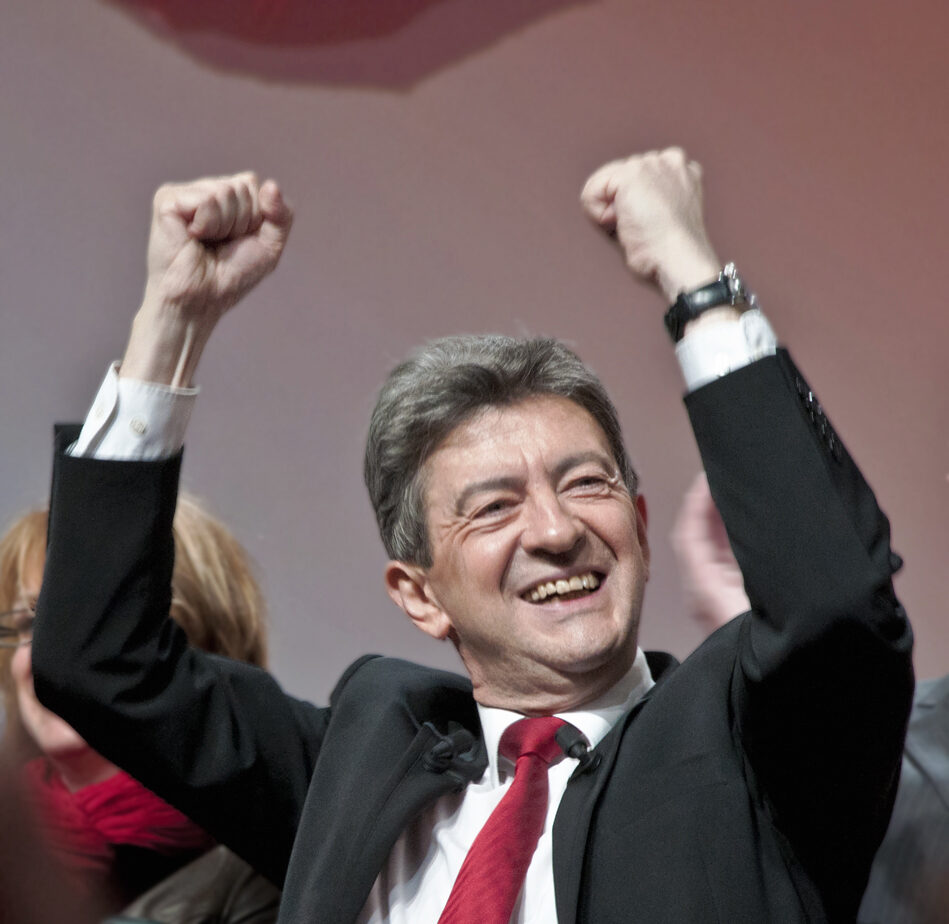
Any left-winger worth his salt will cringe at the words “the great replacement,” supposedly a racist, extreme right-wing conspiracy theory. Jean Luc Mélenchon, the radical left-wing French presidential hopeful, begs to differ. “We represent the New France, the country of the great replacement, where one generation has replaced the other since the dawn of mankind,” he told supporters before announcing that next year he will again run for president.
It was a remarkable choice of words for the ageing leftist firebrand, copied from the right-wing thinker and writer Renaud Camus, who is also an inspiration for the radical right in the United States.
An elderly leftist firebrand facing a young and composed nationalist, currently leading in the polls, how exciting that would be?
Mr Mélenchon, who was born in the Moroccan city of Tangiers in 1951, is playing the race card in his fourth presidential bid. Lately he has seemed to distance himself from France’s white population, calling himself a “Maghrébin,” someone who hails from the Maghreb, lumping together Morocco, Algeria, and Tunisia. Maghrébin has, over the years, acquired a negative connotation in the French language, as a byword for a North African criminal.
Mélenchon’s forebears moved from southern Spain to Algeria in French colonial days. He still has an excellent command of Spanish. His parents later left the Algerian town of Oran for Tangiers, where his parents were to split up. At age 11, young Jean-Luc moved with his mother, a schoolteacher, to Normandy where, he later claimed, he was sometimes called a “bougnoule,” a racial slur aimed at North-Africans. “As many of you also have experienced, I’m sure,” he stated at meeting of his party La France Insoumise, France Unbowed, LFI.
It is by far the largest left-wing party in France, which he leads with an iron discipline since he founded it in 2016. Mélenchon is not a marginal figure in French politics. At the latest presidential elections, in 2022, he fell short of only 420.000 votes to qualify for the run-off against president Emmanuel Macron, nearly beating Marine Le Pen of the radical right.
Since then, he chases the ethnic vote, which he believes to be his natural electoral base. In 2022, no less than 69 percent of French Muslims voted for him, according to polling expert Jérôme Fourquet of the Ipsos institute.
Critics accuse him of kowtowing to the Muslim community, when recently he proclaimed that France’s cathedrals could not haven been built without the expertise of architects from Al-Andalus, the Muslim ruled territory of the Iberian peninsula between 711 and 1492.
At the same occasion, he took a jibe at white people in the audience, reminding them that mankind has originated in Africa, not in Europe. ‘Take that, you ugly whiteys,’ he quipped, leading to accusations of anti-white racism in right-wing French media. Mr. Mélenchon fired his barbs in honor of the recently elected mayor of the town of Saint-Denis, the son of immigrants from Mali called Bally Bakayoko, a rising star in Mélenchons party. Commentators on CNews, the most watched news channel, indulged in blatant racism, comparing M. Bakayoko to a dominating male monkey and falsely claiming that he wanted to disarm the police of Saint-Denis, a poor northern suburb of Paris where white people are few and far between.
Mr. Mélenchon thrives on controversy, a penchant which has led to a seemingly irreparable rift with the more moderate Parti Socialiste (PS) where in the 1980s he had embarked on a modest career. The final straw, for his erstwhile comrades, came last February when he disgusted many with antisemitic dog whistles, insisting on pronouncing Jewish names like Epstein in comically exaggerated “German” fashion. Thereby suggesting, according to critics, that the French pronunciation of Epstein, i.e. Epstine, is meant to conceal its Jewish roots.
Mélenchon’s efforts to butcher more Jewish names, like those of some of his adversaries, greatly amused his audience, but reminded others of similar tactics of the late far-right leader Jean-Marie Le Pen. At each rally of his party, the National Front, he would tick off a list of politicians and journalists he disliked. Many, if not most, of them were Jews.
Mélenchon professes a deep hatred of Israel. He has refused to condemn Hamas for its atrocities in Israel on October 7 2023, which he considers a mere “military offensive.” He poured scorn on the speaker of the second Chamber of the French Parliament, Yaël Braun-Pivet, when she went to Israel to commiserate. According to Mélenchon, Ms. Braun-Pivet, who is Jewish, had “set up camp in Tel Aviv to encourage the massacre of Palestinians.”
The cartoon of a Jewish tv-host in an LFI-publication reminded a commentator in the newspaper Le Monde of the Nazi magazine Der Stürmer.
Before leaving the Parti Socialiste in 2008, Mr. Mélenchon had briefly occupied junior ministerial posts. He has been a member of both houses of parliament, but these last few years has concentrated on leading France Unbowed. In the run-up to next years’ elections, he has expelled the few dissidents who balked at his authoritarian style.
That is a style which, however unpleasant, gives him an advantage over the moderate left, where a rudderless Parti Socialiste is embroiled in petty rivalries, weakening its chances to come up with a credible presidential candidate. The same goes for the moderate right. The only other party with unchallenged presidential candidates is the radical-right’s Rassemblement National, National Rally (RN), of Marine Le Pen. If, in July, her conviction for fraud is upheld, barring her from political office, Jordan Bardella will be the RN’s candidate.
Although beaten in 2022, Mélenchon could celebrate some electoral successes. Polls showed that he was the most voted candidate by well-educated, urban young people. In city boroughs and suburbs with a strong immigrant presence, he secured more than 60 percent of the vote, against 22 percent nationwide. Now, more than ever, he concentrates on the “quartiers populaires,” words which once simply meant working class neighborhoods, but these days refer to areas where a large non-Western population has replaced the autochthonous French. There, the “créolisation,” a word coined by Mélenchon, of the population continues apace.
Since his divorce from his French wife, he has been known to have had liaisons only with ladies of Arab origin. His latest partner has Algerian roots and is a member of Parliament for his party LFI .
Mélenchon has predicted that he will “thrash” Jordan Bardella in their duel for the Elysée. An elderly leftist firebrand facing a young and composed nationalist, currently leading in the polls, how exciting that would be? A battle fraught with dangers for France’s stability, too, increasing the chances of violence in the often Islamized suburbs devoted to Mr. Mélenchon.
READ MORE from René ter Steege:



![Kamala Comes Unglued, Makes Bogus Claim About Her Landslide Loss to Trump [WATCH]](https://www.right2024.com/wp-content/uploads/2025/10/Kamala-Comes-Unglued-Makes-Bogus-Claim-About-Her-Landslide-Loss-350x250.jpg)




![CNN's Kaitlan Collins Fact-Checks Rep. Jasmine Crockett Over False Trump Ballroom Claim [WATCH]](https://www.right2024.com/wp-content/uploads/2025/10/1761954330_CNNs-Kaitlan-Collins-Fact-Checks-Rep-Jasmine-Crockett-Over-False-Trump-350x250.jpg)