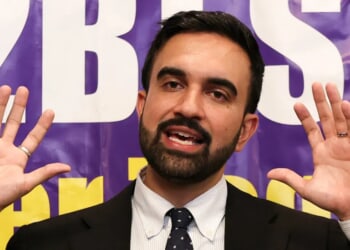
Harrison Layden-Fritz is a Conservative campaigner and political writer. A centre-right free marketeer, he is passionate about restoring opportunity for the next generation and the renewal of Conservatism.
The Left is awake and we must respond. The essential foundation of Conservative recovery is not simply a new policy programme. It is the recovery of our moral clarity and the conviction to defend it.
The Conservative Party entered Opposition carrying a weight that no corporate rebranding exercise or policy reset could dissolve. A tarnished legacy. A fractured trust. An electorate that did not so much choose Labour as conclude that the alternative had lost the will to stand for anything worth voting for.
The cause is not a policy or a leader. It is the cumulative effect of moral abandonment. The British public, with characteristic instinct, saw through it.
The lesson of our age is not complicated, though it is consistently misread. An untethered centre-right does not hold the line. It creates a vacuum, and vacuums are filled.
Consider what happened to the Republican establishment in America. In 2012, Mitt Romney was a qualified candidate by every conventional measure. Experienced, credible, institutionally reassuring. He was chosen because no one feared him, not because anyone believed in him. He was the candidate the establishment could live with. And he lost, because in the face of the near-overwhelming moral clarity, if not policy coherence, of Obama’s agenda, the conservative argument did not muster the required energy to turn the tide.
Into that void stepped Donald Trump. He did not defeat a strong Republican Party. He overwhelmed a hollowed-out one. In 2016, the establishment had the infrastructure, the donors, the experience. Trump had something more powerful in the age of disruption: the moral energy, however crudely expressed, of people who felt their way of life, their economic dignity and their values were being systematically delegitimised. That energy, unrefined and undisciplined as it was, proved more powerful than institutional incumbency every time.
The British parallel is obvious. In the aftermath of the 2024 election, Nigel Farage and Reform UK represented the same dynamic playing out on our own political landscape. The same structural vulnerability. The same hollowed-out centre-right had created the same vacuum. The difference, and it is the only difference that matters, is that the Conservative Party still has time to recover its moral foundations before that vacuum is permanently filled.
The victories of the Cold War era are not ancient history. They are the foundation on which everything we value rests. The defeat of communism, the vindication of free markets, the triumph of democratic accountability over state control, the moral legitimacy of individual aspiration and the right to keep the fruits of your own effort: these were not accidents of history. They were argued for, fought for and won by people who understood that ideas have consequences and that the moral case must be made in every generation or it is lost. In the aftermath, the Left learned. We forgot.
What is now being proposed by the Greens and the left of the Labour Party is not simply a redistributive agenda in the traditional sense. It is a philosophical assault on the moral legitimacy of capitalism itself. Not just higher taxes but the delegitimisation of wealth. Not just regulation but the steady cultural erosion of the idea that striving, succeeding and building something is to be celebrated rather than apologised for.
Of course, this is not new. Bonus caps, frozen tax thresholds, the failure to meaningfully reform welfare or reduce the burden on the productive: Conservative governments were not immune to the same drift. The shift was not sudden. It was gradual, bipartisan and all the more damaging for being unacknowledged. That is precisely why recovery must begin with honesty. Change is not optional.
Now faced with an emboldened Left, too often the centre-right counterargument is about growth impacts or fiscal consequences. It is technical, competent, careful and entirely insufficient. The Left is not making an economic argument. It is making a moral one. A moral assault can only be defeated by a moral counter-offensive made with greater conviction and greater clarity.
Let us be explicit about what that counterargument is, because it has not been restated with sufficient force or frequency.
Capitalism is not merely efficient. It is just. The freedom to build, to own, to risk and to rise is not a privilege to be rationed by the state. It is a birthright to be defended by any government worthy of the name. Personal responsibility is not a burden imposed on the unfortunate. It is the expression of human dignity, the recognition that individuals are capable of directing their own lives and deserve the freedom to do so. Competition is not exploitation. It is the mechanism by which talent is rewarded, innovation is incentivised and prosperity is generated not for the few but for the many.
These are not technical propositions. They are moral ones.
The empowerment and betterment of the individual is not a slogan. It is the organising principle of a free society. Every Conservative policy, every Conservative argument, every Conservative instinct must flow from this foundation. Without it, there is only noise. When the party loses sight of this truth, it does not simply lose elections. It loses its reason to exist.
In the age of disruption, political energy behaves like a kite in a hurricane. The temptation is to release the string and let the wind carry you. That is the Reform offer. Powerful, volatile, exhilarating and ultimately uncontrollable. An unanchored kite does not soar. It is eventually destroyed by the very forces it surrendered to.
The alternative is not to ground the kite. It is to hold the string. A tethered kite can reach extraordinary heights and cover enormous ground, but it remains anchored. In short, it always knows where it stands.
That anchor, for the Conservative Party, is the moral foundation described above. Not a rigid ideology. Not a policy checklist. But a set of convictions about the individual, about freedom, about responsibility and about what a serious nation owes its citizens and demands of them in return. From that anchor, the radius of movement is vast. The agenda can evolve, adapt and respond to the pressures of the age, but it never loses its centre of gravity. Governing requires not just the energy to challenge but the conviction to choose, to know what you stand for when the wind changes direction and how to manage the trade-offs that follow.
We are at the moment when a party in opposition either finds its philosophical soul or commits to wandering without one. Policy follows philosophy. Get the moral foundation right and the agenda that builds on it will be coherent, durable and genuinely transformative. Get it wrong, and you charge magnificently in the wrong direction.
Tennyson understood this. Into the valley of Death rode the six hundred. Boldly they rode and well. But boldness without clarity of purpose is not courage. It is folly. The Light Brigade did not lack conviction or discipline. It lacked the right target, the result of a fatally misread moment. The Conservative Party must not misread this one.
The temptation in opposition is to fight every political skirmish, to respond to every provocation, to react. I often think of the analogy of the outmatched fighter with their back to the wall. Either you mount a doomed offensive or you take down the wall. The path to recovery is not reactive. It is the front-footed, unapologetic assertion of the moral argument we have been too cautious to make. The age of party loyalty is over. Volatility is the new political reality. Only clarity wins. Voters will not be won by competence alone or the promise of managed stability. They will be won by the party that speaks most plainly about what it believes and demonstrates most convincingly that it means it. The green shoots of this renewal are already visible, but we are at the earliest stage of incubation. Making the moral case is the essential precondition of everything that follows.
For those of us fighting for the revival of Conservative politics, the task is not simply to argue for a return to first principles. It is to live them. To show, in everything we say and do and propose, that the moral case for competition, personal responsibility and individual empowerment is not a historical relic but a living argument equal to the age we are entering.
That vision is available to us. It always has been. Britain was once the engine of the world’s progress. The nation that industrialised before anyone else, that built the institutional foundations of modern capitalism, that gave the world the rule of law, parliamentary democracy and the presumption of individual liberty. That inheritance is not a source of nostalgia. It is a source of obligation. The obligation to be worthy of it. To defend it when it is challenged and to extend it into the century ahead.
The moral case has not been defeated. It has been abandoned. It is time to make it again.






![CNN's Kaitlan Collins Fact-Checks Rep. Jasmine Crockett Over False Trump Ballroom Claim [WATCH]](https://www.right2024.com/wp-content/uploads/2025/10/1761954330_CNNs-Kaitlan-Collins-Fact-Checks-Rep-Jasmine-Crockett-Over-False-Trump-350x250.jpg)

![Two Dead, 14 Injured After Gunfire Erupts Following College Football Game in Alabama [WATCH]](https://www.right2024.com/wp-content/uploads/2025/10/Two-Dead-14-Injured-After-Gunfire-Erupts-Following-College-Football-350x250.jpg)