Papal trips are usually not much followed, except for the end, when a Pope, during an in-flight press conference, talks to journalists who accompany him. This time, Pope Leo XIV’s journey to Africa attracted immediate attention because of the polemic sparked by President Donald Trump’s remarks about the first North American Pope, who is “weak on crime” and “terrible on foreign policy.”
The Bishop of Rome was already on the plane at the beginning of the trip when he reacted, saying he had “no fear” of the Trump administration. His longest journey to date, a one-and-a-half-week-long journey, comprising four African states, concluded on 23 April. (RELATED: ‘I Have No Fear’: Pope Leo Responds To Trump’s Biggest Attack Yet)
The focus of most of mass media was not so much on Africa, and many tried to read the papal speeches during the apostolic trip through this Trump-Pope lens. Leo XIV, like his recent predecessors, appealed to peace and justice and condemned war, corruption, and exploitation. The pontiff then spoke about the short-sighted misinterpretation, telling journalists it was “not my interest” to debate Trump.
The speeches and homilies are typically prepared weeks ahead and reflect primarily the local challenges and context.
“Touring Africa, Pope Leo Raised His Voice, but Didn’t Like The Echo,” The New York Times wrote, saying that Leo used “the most forthright comments since becoming pope last year, but grew uncomfortable at how that criticism was interpreted.”
French daily Le Monde ran a comment entitled “The Vatican is clearly in rupture with the worldview of Trump.”
However, the Pontiff’s “mild and balanced reaction” to Trump’s words, stressing he is “a pastor visiting people,“ avoiding political chat, “earned him a global stature he did not have at the beginning,” said a Vatican source for the Daily Caller. (RELATED: Vatican Issues Rare Public Rebuke Of ‘Completely Untrue’ Media Reports About Relationship With Trump Admin)
At the same time, mainly Catholic and some secular media focused on Leo as a “pilgrim lion of peace” (Leone in Italian, Léon in French). Moreover, African theologians and intellectuals explained Leo’s decision to visit their homeland as a way to acknowledge its rising Catholic population and growing importance in the world. He may also have wanted to bring the ongoing suffering, conflicts, and wars to global attention.
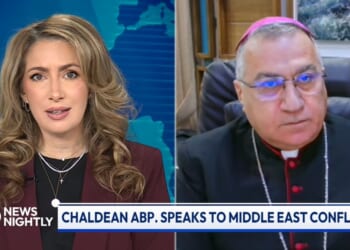
It was for the first time that a pontiff visited Algeria, a predominantly Muslim state and the birthplace of St. Augustine, the spiritual father of the first Augustinian Pope. Some called it “a historic moment under the sign of dialogue,” and the magazine of the Grand Mosque in Paris published Leo’s image on the front page with the title, “Leo XIV in Algeria: as if the other one were already us.”
In France, some wanted the Pope to visit Tibhirine, where French Trappist monks were kidnapped from a monastery and murdered by terrorists 30 years ago. The same year, the French bishop in Oran, Pierre Claverie, was killed, too. They were later beatified, meaning the Catholic Church recognized that they lived a good life, which can lead to their sainthood (the recognition that a person is in heaven).
Another Frenchman declared a saint more recently was killed in Algeria 110 years ago, the missionary Charles de Foucauld.
The papal absence at those “crime scenes” could be explained by the Holy See’s desire to avoid a still politically sensitive issue, perhaps coupled with safety concerns in some areas and logistical constraints.
Algeria, which was a French colony for some time, is actually the largest country on the African continent.
In Cameroon, which has a mainly Christian population, with a small yet still significant Muslim community, the pontiff also met the local community, which suffers from a long conflict known as the ‘Anglophone Crisis’ and tensions between its English and French-speaking parts. The Pope appreciated that the regional crisis “has brought the Christian and Muslim communities closer,” whose “leaders have united and founded a peace movement, through which they seek to mediate between the opposing sides.” (RELATED: Pope Leo XIV Calls On African Youth To Improve Own Countries Rather Than Migrate Somewhere Else)
Pope Leo warned that “the world is being ravaged by a handful of tyrants.” According to him,” the masters of war… turn a blind eye to the fact that billions of dollars are spent on killing and devastation, yet the resources needed for healing, education and restoration are nowhere to be found.”
It was an implicitly political trip, according to some analysts, who stressed that in Cameroon and Equatorial Guinea, the political leaders have been in power for decades.
The leader of the largest Christian church in the world continued his appeals to the Gospel and to justice in mainly Christian countries, such as Angola, rich in natural resources, and Equatorial Guinea, the only African country whose official language is Spanish.
Pope Leo met various local representatives and authorities and delivered speeches and celebrated masses. He visited, among other places, the Bata prison in Equatorial Guinea. “Life is not defined solely by one’s mistakes”, as “there is always the possibility to start over,” he said.
In a conversation with Vatican media, the prison chaplain, Pergentino Mba, considered Leo’s presence important, as it encouraged the church’s work with prisoners and staff to “promote a climate of respect and humanity.”
At the press conference on the plane, the Pope spoke about same-sex blessings, the war in Iran, and how to keep the church united. One journalist said the Pope met some of the most authoritarian leaders in the world, and asked him how to avoid giving their regimes moral authority. (RELATED: Cuba Reportedly Pleads With Vatican To Get The US Off Its Back As Energy Crisis Grows)
Pope Leo XIV admitted there could be various interpretations, but emphasized that the Holy See maintains “sometimes with great sacrifice… diplomatic relations with countries with authoritarian leaders so that we can speak with them.”
The 267th Pope of the Catholic church said that “we do not always make great proclamations—criticizing, judging, or condemning,” as there is a lot of work behind the scenes to promote justice, humanitarian causes, and so on.
Bohumil Petrík is the only journalist from former Czechoslovakia accredited to the Holy See. He was an intern with EWTN in Rome before joining Vatican Radio, and later was a trainee in the communications department of the European Parliament in Brussels. He writes for various media outlets currently from Rome.
![Kamala Comes Unglued, Makes Bogus Claim About Her Landslide Loss to Trump [WATCH]](https://www.right2024.com/wp-content/uploads/2025/10/Kamala-Comes-Unglued-Makes-Bogus-Claim-About-Her-Landslide-Loss-350x250.jpg)