Press Releases
|
May 01, 2026
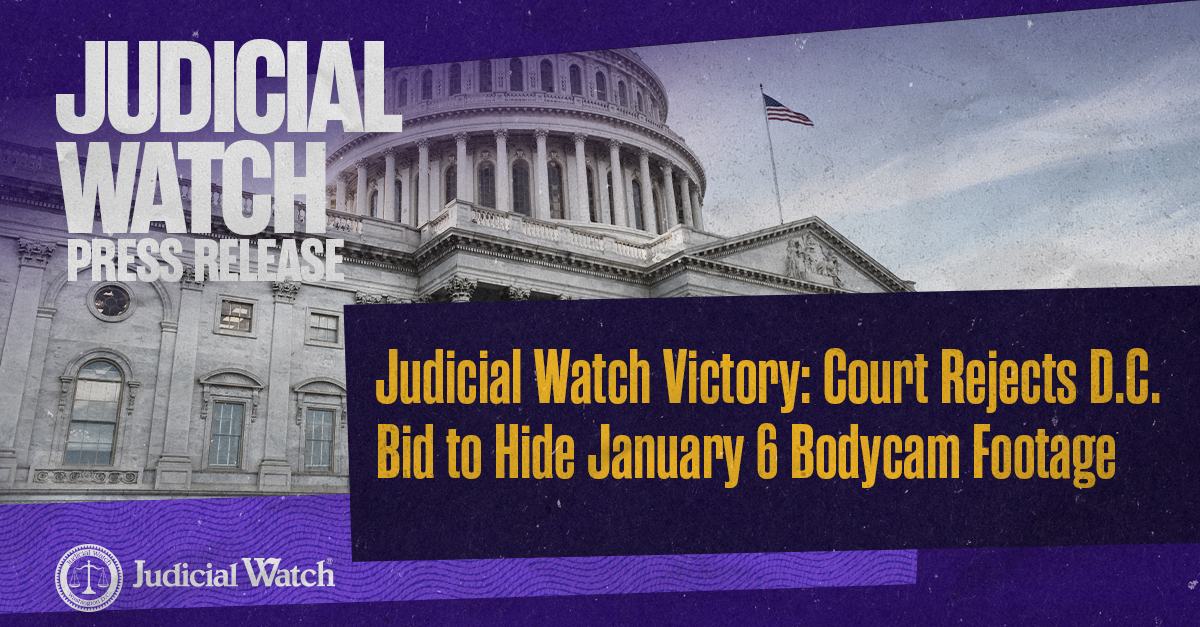
(Washington, DC) – Judicial Watch announced today that a Washington, D.C. court ruled that Washington D.C.’s Metropolitan Police Department (MPD) cannot broadly blur and censor body-worn camera (BWC) footage from January 6, 2021. The MPD had previously claimed that such redactions were necessary to protect personal privacy and asserted that complying with the request would cost more than $1.5 million due to the volume of footage, which reportedly exceeds one thousand hours.
The ruling follows a January 8, 2026, hearing before Judge Veronica Sanchez in Judicial Watch’s Freedom of Information Act (FOIA) lawsuit for all bodycam footage recorded by Metropolitan Police officers who responded to the U.S. Capitol on January 6 (Judicial Watch v. District of Columbia (No. 2024-CAB-003453)).
In its order, the court rejected the District’s argument that it could justify redacting under D.C. FOIA exemptions the faces and voices of all non-law enforcement individuals captured in the footage.
The court found that while individuals appearing in the footage may have a limited privacy interest, that interest is minimal and does not outweigh the strong public interest in disclosure. The court emphasized that the events of January 6 occurred largely in public settings, were widely recorded, and remain a matter of significant national concern.
Concerning the individuals’ privacy interests, the court explained that the individuals present could not reasonably expect that their appearances would remain private:
The circumstances leading up to the events at the U.S. Capitol Complex included a large, public, televised event on the National Mall. Individuals were gathered in a public arena. The crowd then marched to the U.S. Capitol Complex where members of congress were partaking in the certification of the Presidential election results live on television.
***
The individuals on the [body-worn cameras] could not “reasonably expect that their appearances on the [BWC] would remain private.” … A person’s privacy interest is greater in the release of images and video footage that were taken without their “knowing consent.” … Even though the individuals recorded on the subject BWCs may not have consented to their images being recorded, they certainly had reason to believe that the many law enforcement officers, as well as the surveillance cameras at the government owned property, were recording them. Additionally, during the events of January 6, simultaneous media images from both inside the U.S. Capitol and around the U.S. Capitol Complex were being broadcast, streamed, and uploaded. While the individuals may have not all “knowingly consented” to the images being recorded, they had reason to know they were.
Concerning the public interest, the court stated:
The events of January 6, 2021, have been the topic of much debate, discussion, and scrutiny in the public consciousness by not just the residents of the District of Columbia but also the nation. BWC footage of the events at the Capitol on January 6 could “contribute significantly” to the public’s understanding of the events on that day and the MPD’s actions.
The court concluded, “In balancing the privacy interests which are little more than de minimis with the public interest, the public interest outweighs the privacy interests. … [T]he faces and voices of individuals captured by MPD’s BWCs on January 6, 2021, are not exempt from disclosure.”
“This a major victory for transparency and the rule of law,” said Judicial Watch President Tom Fitton. “As the court found, the American people have a right to see this secret D.C. police January 6 footage. Judicial Watch will now push for the immediate release of the videos.”
Judicial Watch has extensively investigated the events of January 6.
In April 2026, Judicial Watch filed a Freedom of Information Act (FOIA) lawsuit against the Internal Revenue Service (IRS) to obtain records related to possible improper targeting of January 6, 2021, Capitol protesters, their supporters, and related nonprofits
In August 2025, Judicial Watch announced that the U.S. Air Force would finally provide full military funeral honors to Ashli Babbitt, the Air Force veteran who was shot and killed inside the U.S. Capitol by then-Capitol Police Lt. Michael Byrd on January 6, 2021. Babbitt was the only official January 6 homicide victim. The Biden administration had previously denied Babbitt and her family these honors in retaliation for being at the U.S. Capitol that day. This decision came on the heels of a massive, nearly $5 million Trump administration settlement to her family for wrongful death and other claims against the U.S. Government.
In July 2025, Judicial Watch sued the U.S. Department of Justice for records on accelerated January 6 prosecutions after Donald Trump was elected president in November 2024. The Biden administration, anticipating President-elect Donald Trump’s promise to issue pardons for January 6, 2021, defendants, is believed to have accelerated prosecutions in the final months of Biden’s term.
In March 2024, Judicial Watch received Bureau of Alcohol, Tobacco, Firearms and Explosives (ATF) records from the Department of Justice in a Freedom of Information Act (FOIA) lawsuit that show the Central Intelligence Agency (CIA) deployed personnel to Washington, DC, on January 6, 2021.
October 2023, Judicial Watch received the declaration of James W. Joyce, senior counsel in the Office of the General Counsel for the Capitol Police, in which he describes emails among senior officials of the United States Capitol Police (USCP) in January 2021 that show warnings of possible January 6 protests that could lead to serious disruptions at the U.S. Capitol.
###

![James Carville Admits Democrats Had No Shutdown Endgame, Mishandled Strategy [WATCH]](https://www.right2024.com/wp-content/uploads/2025/11/1763070634_James-Carville-Admits-Democrats-Had-No-Shutdown-Endgame-Mishandled-Strategy-350x250.jpg)

![Two Dead, 14 Injured After Gunfire Erupts Following College Football Game in Alabama [WATCH]](https://www.right2024.com/wp-content/uploads/2025/10/Two-Dead-14-Injured-After-Gunfire-Erupts-Following-College-Football-350x250.jpg)