Scarcity is the natural state of the world, but man is curious and innovative, ingenious and resourceful, eager to operate on the world as he finds it and to improve his condition. “We speak of art as distinguished from nature; but art itself is natural to man,” the Scottish thinker Adam Ferguson wrote. “He is in some measure the artificer of his own frame, as well as of his fortune, and is destined, from the first age of his being, to invent and contrive.” This disposition has produced innovations from the wheel and the plow to the steam engine, the telegraph, and the airplane — and, in an age whose history is increasingly being written in ones and zeroes, the digital panoply of the internet and artificial intelligence (AI).
The linguistic gamesmanship … obscures a more elementary fear: that entrepreneurs and innovators might create things not imagined by … the enlightened technocrats of Washington, D.C.
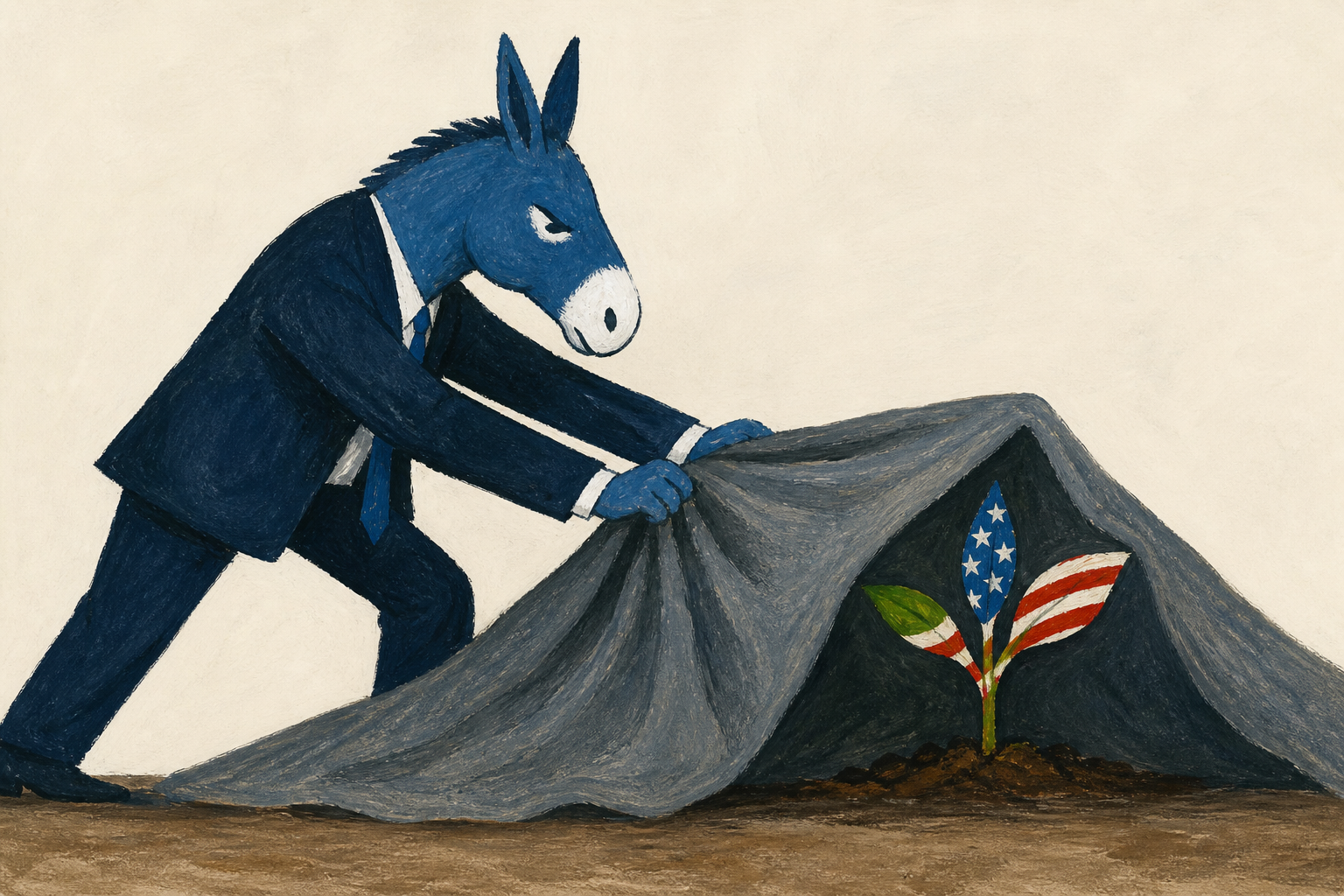
But with every batch of innovation and economic progress comes a fit of techno-skepticism and panic; the Luddite impulse will never be quelled entirely. Most recently, Sen. Bernie Sanders (I-Vt.) and Rep. Alexandria Ocasio-Cortez (D-N.Y.) introduced “legislation that would enact a reasonable pause to the development of AI to ensure the safety of humanity.” The linguistic gamesmanship of “reasonable” and “safety of humanity” obscures a more elementary fear: that entrepreneurs and innovators might create things not imagined by — and beyond the management of — the enlightened technocrats of Washington, D.C. (RELATED: When AI Meets the State)
The Sanders–Ocasio-Cortez bill would impose a moratorium on the construction and innovation of data centers. Further, it anticipates further legislation that would require AI products to secure regulatory approval before entering the market. The title of a recent essay Sanders authored in The Wall Street Journal aptly sums up his position: “AI Is a Threat to Everything the American People Hold Dear.” (RELATED: Newsom Backtracks on AI Rules)
This piece dispenses with traditional boldness of America — which holds that industry and innovation ought to be insulated from the meddling of lawmakers and bureaucrats until tangible (not merely hypothesized) dangers arise — in favor of a frightened, defensive posture that considers innovation to be danger, change to be suspect per se, and individuals and corporations working freely to better their own lot and the lots of the fellow citizens as likely enemies of the public.
More practically, a suppression of AI and the infrastructure on which it relies will harm the very individuals Sanders seeks to protect. AI products have been ushered into the legal industry, the healthcare industry, and real estate, among many others. According to Kimberly Tan, “29 percent of the Fortune 500 and ~19 percent of the Global 2000 are live, paying customers of a leading AI startup.” Farmers have deployed AI and automation to reduce their use of pesticides, manufacturers — including small manufacturers — to become more productive, and medical innovators to diagnose, treat, and otherwise assist the sick.
Innovations that never emerge and the businesses that never succeed because of regulatory excess cannot be quantified empirically and memorialized in an economist’s spreadsheet. However, to imagine the prosperity Sanders and AOC would have the American people forgo, imagine the 21st century deprived of the automobile, the computer, or penicillin. Charts and graphs cannot convey everything, but the success of human effort — fortified by free markets in the rules of law — is manifest in the trendline of the last seven decades, during which global GDP per capita rose nearly fourfold.
Prosperity is not, as many would have it, a mere policy choice, but the suppression of entrepreneurial endeavors that create it is. Sanders would not, presumably, wish to forgo air travel and modern medicine. But having the luck to enjoy these great goods, he seeks an end to the system of free enterprise that created them.
At least in spirit, Sanders and Ocasio-Cortez align more with the Aristotelian idea that what the law doesn’t explicitly allow is forbidden, rather than the Western rule of law tradition, where people are free to do anything not prohibited. Central planners did not invent the economic and technological progress that built the modern world; instead, individuals, associations, corporations, and institutions — protected by legal frameworks which provide indispensable security and certainty — have carried on the process of invention for themselves. Allowing panic to prevail and legislating as if AI unmanaged endangers the very existence of the American republic will halt this process, enervating the very institutions — the economic and legal order — that have created the wealthiest and most powerful nation in history.
“The next generation isn’t being bulldozed by AI; they’re partnering with it,” reads a letter from a WSJ reader disputing Sanders’ Ludditism. “This reflects the entrepreneurial spirit at its best—human creativity cooperating with the gifts of reason and invention.” Whether the entrepreneurial spirit of America is to be snuffed out by timid technocracy is the question at hand.
READ MORE from David B. McGarry:
The Lost Children of the Kids’ Online Safety Debate
Parents Have Everything They Need to Keep Their Children Safe Online
David B. McGarry is the research director of the Taxpayers Protection Alliance.




![James Carville Admits Democrats Had No Shutdown Endgame, Mishandled Strategy [WATCH]](https://www.right2024.com/wp-content/uploads/2025/11/1763070634_James-Carville-Admits-Democrats-Had-No-Shutdown-Endgame-Mishandled-Strategy-350x250.jpg)