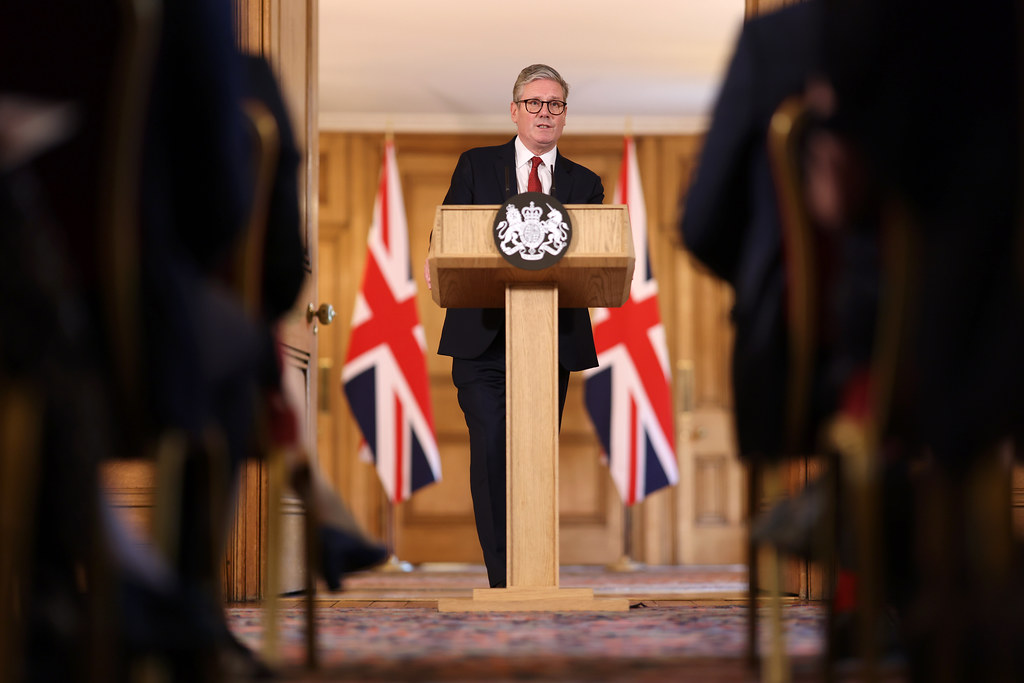
On St George’s Day the Prime Minister condemned “plastic patriots.” These are, he said, the people who hijack the flag to spread hate.
Why the reminder of our DisunitedKingdom? 23rd April marks Shakespeare’s birthday: he distilled the essence of this country, especially in the history plays. No.10’s comms team could have ditched the disunity and instead leant into “This other Eden, demi-paradise”.
The story of England (and Britain) is also the story of this country’s wars – and, as in Shakespeare’s Henry V, of this country’s soldiers.
The few, the happy few, the band of brothers were roused to “Cry God for Harry, England and St George” and go once more unto the breach; otherwise, the French enemy would “close up the wall with our English dead.”
Contrary to media reports when it first came onto the public radar around 2007, the Military Covenant did not date back to Henry V. Neither was it signed by Oliver Cromwell or the Duke of Wellington. Soldiers at Blenheim, Corunna, the Somme, El Alamein, in the Falklands, the Gulf or Northern Ireland would never have heard of it.
The principle of Military Covenant was ancient: the nation’s support for soldiers and veterans, in exchange for soldiers’ service to the nation. The Covenant is, however, recent. It was formalised by a small team in the Army in the late 1990s, became part of military doctrine – only for the Army promptly to forget about it.
From 2003, the trigger-happy Blair and Brown governments were keen to send the Forces to Iraq and Afghanistan, but wanted conflict on the cheap.
Warfighting on two fronts, but undermanned, underequipped and under-supported by the public, the Army needed to convey that servicemen and women were paying a lethal price for the Labour government short-changing the Forces.
In 2006, the Army remembered the Military Covenant, blew the dust off, then deployed it to get its message across. Soldiers were doing their bit; the country must reciprocate.
A trust-based concept, based not on law but on the moral principle of reciprocity, the Covenant turned out to be a powerful weapon.
It helped rally Britain to back “our boys” (and our girls). It conveyed to the country that the government was ignoring its duty of care to the Forces’ personnel who were being put in harm’s way. Despite that, they were upholding the Covenant and serving the nation: 179 personnel were killed in Iraq, 457 in Afghanistan: hundreds more were seriously wounded.
Two decades on, another Labour government is breaking the Covenant with the Armed Forces.
It is not every day that an Attorney-General is associated with treason. At Policy Exchange on Wednesday Tom Tugendhat MP condemned Lord Hermer for his role in a witch hunt against British troops falsely accused of war crimes in Iraq.
Among the accused was Lance Corporal Brian Wood MC. The accusers turned out to be Iraqi insurgents, backed by the Iranian Revolutionary Guard Corps. Their lawyers included Phil Shiner, later struck off and convicted of fraud, who appears to be linked to Hermer. Nick Timothy MP has referred the A-G to the Bar Standards Board.
In February, the PM stated that as soon as there were any allegations of wrongdoing, he had “absolutely nothing to do with” Shiner, a claim which Charlie Dewhurst MP immediately challenged.
The government signalled this week it is happy to let the hounding of veterans of the Northern Ireland Troubles continue, as Katie Lam set out. Like the false accusations against the soldiers in Iraq, the vexatious legal action against the veterans is distressing for those subjected to it.
Anti-British sentiment in Ireland is often blithely overlooked. Legal action – “lawfare” – against veterans is perceived by some Republican supporters as a means of continuing the fight against Britain and British troops: “the process is the punishment.”
The Human Rights Act not only facilitates lawfare against soldiers and veterans, but since it was introduced into the battlespace, is undermining combat effectiveness.
US commander General David Patraeus reminds Spectator readers that soldiers are already bound by the Law of Armed Conflict: he warns against competing legal frameworks. On Armistice Day, three former Army Chiefs were among nine military leaders warning that lawfare will lead to Britain losing its fighting edge “exactly the moment it is most needed.”
Keir Starmer claims he is putting Britain on a “war footing”. Defence, however, needs more than money. It relies on Armed Forces personnel, whose morale is being undermined by the lawfare being championed by Labour.
Today’s Armed Forces Covenant, focused on the welfare of the Forces’ community, evolved from the Military Covenant – rooted in the unique role of soldiers who are prepared to put their lives on the line defending the nation.
The Prime Minister is not averse to hijacking the Union flag for photo ops. Next time he stands beside it, why not ask exactly who the plastic patriot is.






![CNN's Kaitlan Collins Fact-Checks Rep. Jasmine Crockett Over False Trump Ballroom Claim [WATCH]](https://www.right2024.com/wp-content/uploads/2025/10/1761954330_CNNs-Kaitlan-Collins-Fact-Checks-Rep-Jasmine-Crockett-Over-False-Trump-350x250.jpg)